Home › Industrial Floors and Specialty Slabs
Reliable, professional industrial concrete floor in Austin, TX from Superior Concrete Austin. Contact us today for a free on-site estimate.
Superior Concrete Austin provides professional industrial concrete floor throughout Austin, TX, Texas and the surrounding area. Our licensed, insured crew delivers safe, clean, on-time work with a free estimate before anything begins. Call (737) 258-3740 or request your free quote.
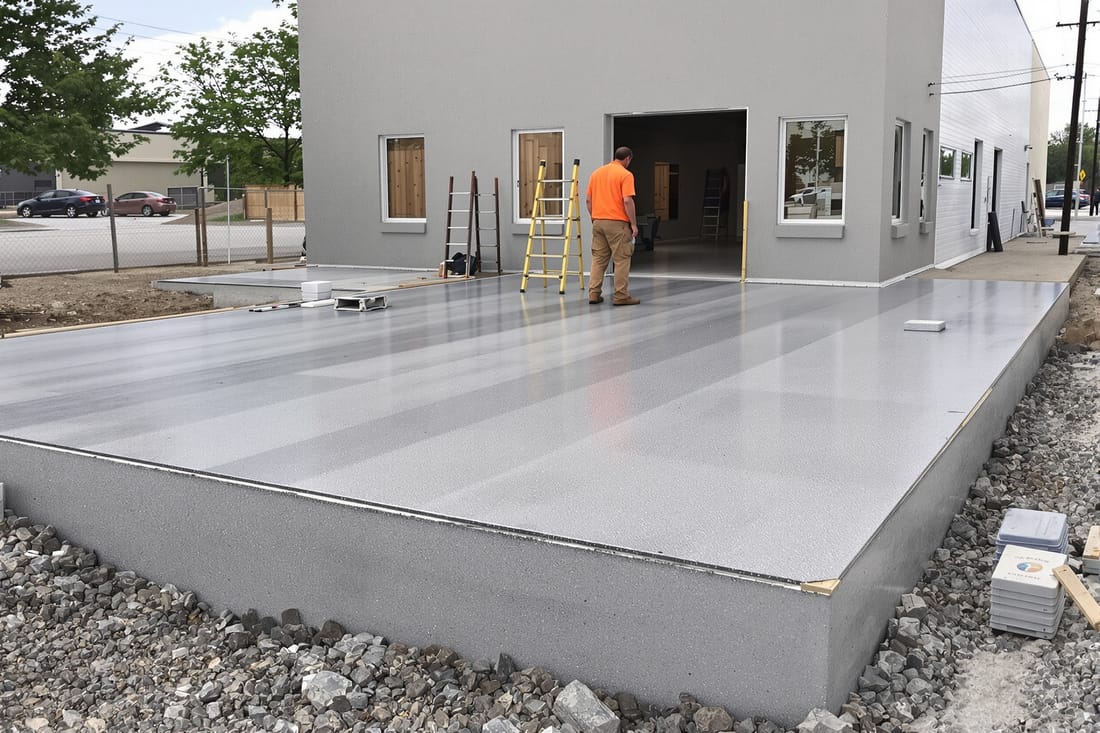
Industrial Concrete Floors Built for Austin Worksites
Industrial concrete floors are not just thicker versions of a house slab. They carry forklifts, racking, heavy machinery, and constant traffic, so every decision from mix design to joint layout affects how your facility operates. At Superior Concrete Austin, we build industrial floors and specialty slabs that match the real loads and wear your operation will see, not a generic one-size spec.
We start by learning how you use the space: forklift types and wheel loads, rack layout, potential impact zones, chemical exposure, wash downs, and future expansion plans. An Austin distribution warehouse that runs narrow aisle lifts needs a different floor than a South Austin fabrication shop with anchored machinery and hot work. Once we understand the use, we work with engineers to select slab thickness, reinforcement, and joint spacing that keep cracking and curling under control.
Our team is local to the Austin area, so we also factor in Central Texas soils, heat, and sudden thunderstorms. Poor subgrade preparation or rushed curing is a big reason industrial floors fail early around here. We take extra care with base compaction and drainage, and we sequence pours to avoid finishing in the peak afternoon heat whenever possible.
Planning, Engineering, and Permits in Austin, TX
Before anything is poured, we help you confirm that the floor system matches City of Austin requirements and your building engineer’s design. For most industrial projects, an engineered slab design is required, especially for new construction, change of use permits, or when adding heavy equipment to an existing warehouse.
Superior Concrete Austin coordinates with your structural engineer or can connect you with one if you are early in planning. We review live loads, point loads under racks or columns, and any special impact or vibration criteria. If your project is inside the Austin city limits or ETJ, plans usually go through the city’s commercial plan review, and inspections are scheduled for subgrade, reinforcement, and final pour. We provide all mix design submittals, reinforcement details, and curing methods so your permit reviewers and inspectors have clear documentation.
For tenant improvements in existing spaces, we often core test the existing floor to verify thickness, reinforcement, and compressive strength before cutting or thickening slab areas for new equipment. This avoids surprises and helps you stay compliant if the landlord, fire marshal, or city asks for documentation on your industrial concrete floor capacity.
How We Build Durable Industrial Concrete Floors
On site, the first step is subgrade evaluation and preparation. Central Texas soils can vary from firm caliche to expansive clay, sometimes on the same site. We undercut soft spots, compact to specified density, and typically use a crushed limestone base for drainage and uniform support. A poor base is the fastest way to turn a new industrial floor into a maintenance headache.
Formwork is set to tight elevations, then vapor barriers are installed where required, usually under temperature-controlled or moisture-sensitive areas. We place reinforcement according to design, which might be post-tension cables, rebar mats, or steel fibers in the mix. Fibers are common for warehouse slabs in Austin because they help control shrinkage cracking and reduce the need for a dense bar grid.
Concrete placement is timed to avoid extreme temperatures when possible. We use ready-mix suppliers familiar with industrial mixes, often specifying higher strengths, low water-cement ratios, and admixtures for set-control or improved workability. Screeds and laser-guided equipment bring the slab to elevation, then our finishers work the surface to the required texture. For many industrial floors we target a specific flatness and levelness (FF/FL) so your racking, conveyors, and forklifts run smoothly.
Curing is not an afterthought. We apply curing compounds or use curing blankets and control traffic on the new slab to limit early-age cracking. Proper curing is especially critical in Central Texas heat where unprotected surfaces can dry too quickly.
Specialty Slabs: Heavy Equipment Pads, Freezer Floors, and More
Industrial facilities in Austin rarely need just a simple uniform slab. Superior Concrete Austin routinely installs specialty slabs to solve specific problems. Heavy equipment pads might require thicker sections, double mats of rebar, and embedded anchor bolts for CNC machines, presses, or rooftop mechanical units set at grade. We coordinate bolt patterns, conduit routes, and machine leveling requirements so your installer has a precise base to work from.
Freezer or cold storage floors have unique needs. To prevent frost heave, the slab design may include insulation, vapor barriers, and sometimes under-slab heating or ventilation systems. We make sure joints, insulation laps, and vapor barriers are coordinated with your refrigeration contractor so warm and cold zones are properly separated.
For areas with frequent wash downs or chemical exposure, such as brewery production floors, food processing, or certain manufacturing uses common around Austin, we adjust mix design and surface treatment. This might include lower permeability concrete, carefully detailed slopes to trench drains, and surface prep for epoxy or urethane coatings. If you are planning to install a specialty coating, we leave the surface profile and moisture conditions that your coating installer specifies, instead of over-finishing the concrete.
Industrial Concrete Floor Options: Joints, Finishes, and Reinforcement
There are many configuration options, and choosing smartly up front reduces long-term repair costs. For slab joints, we plan a layout based on your rack aisles, columns, and traffic paths. We can provide traditional sawcut control joints, doweled construction joints, or, where budgets allow, jointless or large-panel floors that dramatically reduce forklift bumps and spalling.
Surface finish options include hard trowel finishes for dry warehouse areas, lightly broomed textures for traction in loading zones, or intentionally roughened surfaces for future epoxy or polish. Polished industrial concrete floors are popular in Austin for distribution centers and tech manufacturing, since they resist dusting and are easier to clean. When polishing is planned, we adjust finishing and curing so the surface is suitable for later grinding and densification.
Reinforcement can be conventional rebar, welded wire mesh, post-tension cables, or steel fibers. Post-tensioned slabs are often used where soil movement is a concern, such as parts of East and South Austin with expansive clay. Fiber-reinforced concrete is common for large warehouse floors where minimizing joint count and crack width is a priority. We explain the tradeoffs in cost, performance, and schedule for each option so you can pick what fits your operation and budget.
Cost Factors and How to Budget for an Industrial Concrete Floor
Industrial concrete floor costs in Austin vary widely, and it is not just about price per square foot. The main drivers are slab thickness, reinforcement type, required flatness and levelness, base preparation, and any specialty features like embedded rails, drains, or equipment pads.
A high-traffic distribution center with narrow aisle forklifts might require tight flatness tolerances and a mix design tailored for low shrinkage, which increases both material and labor cost. A light industrial workshop might be more forgiving. Specialty slabs for heavy machinery or freezers are priced separately, since they often include additional excavation, thicker sections, and complex reinforcement details.
Existing building conditions matter too. If we are replacing an old slab in a North Austin warehouse, sawcutting, demolition, disposal, and potential subgrade repair will influence pricing. Access for concrete trucks and pumps also affects cost, especially in tight urban infill sites or inner-city Austin neighborhoods.
Superior Concrete Austin provides detailed written proposals that break out base prep, reinforcement, concrete placement, finish, curing, and joint treatment. We also discuss optional upgrades, such as dowel baskets for joints or surface hardeners, so you can see which items truly add long-term value for your industrial floor.
Common Problems With Industrial Floors and How We Prevent Them
Many of the calls we get in Austin are from owners frustrated with cracking, joint spalling, or dusting on relatively new floors. While some hairline cracking is normal, excessive or wide cracks usually trace back to insufficient reinforcement, poor joint layout, or rushed curing. We address this by matching joint spacing to slab thickness, specifying realistic reinforcement, and enforcing curing procedures, even when schedule pressure is high.
Joint damage from forklifts is another frequent issue. Thin or poorly doweled joints break down under repeated wheel loads, especially in warehouse aisles. To avoid this, we use appropriate dowels or proprietary load transfer systems and make sure joint locations avoid direct alignment with concentrated rack loads whenever possible.
Dusting and surface wear often show up in older Austin facilities with underpowered floor slabs. We combat this with proper finishing techniques, adequate cement content, and sometimes dry shake hardeners for high-wear zones like loading docks. If you already have an underperforming industrial concrete floor, Superior Concrete Austin can evaluate it and recommend repairs such as joint rebuilding, partial slab replacement, or surface treatments like densifiers or overlays. Our goal is to give you a floor system that supports your operation for the long term, not just until the warranty runs out.